St Asicus
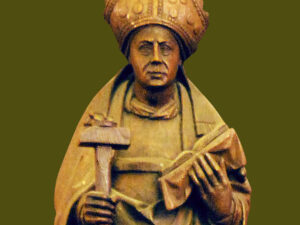 St. Asicus, also called Ascicus and Tassach, is the patron saint of the Diocese of Elphin. The patron saint of Coppersmiths, St Asicus is buried at the top of a field between Donegal Town and Ballyshannon near Ballintra. He was a skilled coppersmith and silversmith, and copperwork can be seen on the shamrock-patterned beaten brass altar screen in the Cathedral of the Immaculate Conception in Sligo. He was one of the earliest of St. Patrick’s disciples and after St. Patrick established the Diocese of Elphin in County Roscommon, circa. 450 AD, he appointed Asicus as its first bishop. He was later Abbot-Bishop of Ireland.
It is said that he was a humble man and often troubled by thoughts that he was not worthy of his high office in the Church. He left Roscommon and travelled to Rathlin O’Birne Island in Donegal Bay where he resigned his office and became a hermit, living for a while at the top of Sliabh Liag (Slieve League) along the area called The Pilgrim’s Way.
He remained there for seven years until he was found by the monks of Elphin who persuaded him to return to Elphin with them. However, he was not in good health and died on the journey back to Elphin (circa. 490 AD). He is buried where he died – near the village of Ballintra between Ballyshannon and Donegal Town. His feast day is the 27th of April.
You can find his grave along the road from Ballyshannon to Donegal Town, just before the turn off to Rossnowlagh. Turn off the main road to the left and a short distance along the narrow lane you will see the gateposts on your right, as in the picture in the gallery here below. The grave is just up the hill beyond the gates.
St Nathy
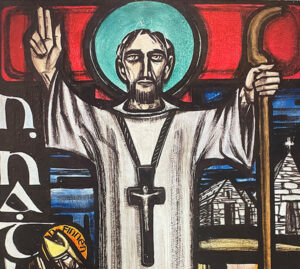 A pupil of St Finian of Clonard, Nathy had a reputation for holiness. St Finian put him in charge of a monastery at Achonry. It is probably for this reason that, sometime after the diocese was formally erected at the Synod of Kells in 1152, Nathy was named as the patron of Achonry diocese.
Along with St Attracta, St Nathy is patron of the diocese of Achonry. Achonry (Irish Achadh Chonaire, “the field of Conaire”) is a village between Ballymote and Tubbercurry in Co Sligo and was the site of the original monastic foundation in the area. The diocese was formally erected by the Synod of Kells (1152) and includes parishes from the counties of Sligo, east Mayo and north-west Roscommon.
Few details are known from records about the life of St Nathy or, as he is often called, Crumther Nathy or Cromnathy (Irish Cruimhthir, a priest). He was a native of Lugne territory, now commensurate with the barony of Leyny in Co Sligo.
He studied under St Finian at Clonard, who established a monastery at Achonry shortly before his death in 552. Finian appointed his pupil Nathy in charge of the monastery, which became a school of piety and learning. St Fechin, probably born in the locality, was its most famous disciple; he went on to found his own monastery at Fore in Co Westmeath.
The Félire of Oengus tells us St Nathy is buried at Achadh Cain. His feast day is celebrated on 9th August.
St Attracta
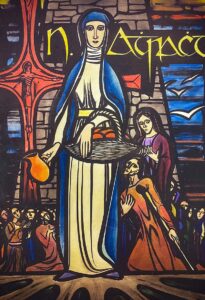 Legend claims she was the daughter of a nobleman, Talan Cathbadi, who refused to allow her dedicate her life to God. She fled to Coolavin where she is said to have received the nun’s veil from Saint Patrick himself. However, in the Latin Life of Saint Attracta, which has survived, those recorded as her contemproaries lived in the sixth century, long after the death of Patrick.
She founded a hospice in Killaraght and this convent continued until the supression of the monasteries in the sixteenth century. The Cross and Cup of Attracta were much revered relics of the saint in Killaraght. Early in the fifteenth century the parish priest complained to Rome that they were being taken from the church by clerics and laity, to use for their own profit. Some time later they disappeard. Throughout the dicoese a number of holy wells were dedicated to her, such as the one at Clogher, Ballaghaderreen. Attracta remains a popular girl’s name locally. Her feast day is celebrated on 11th August.